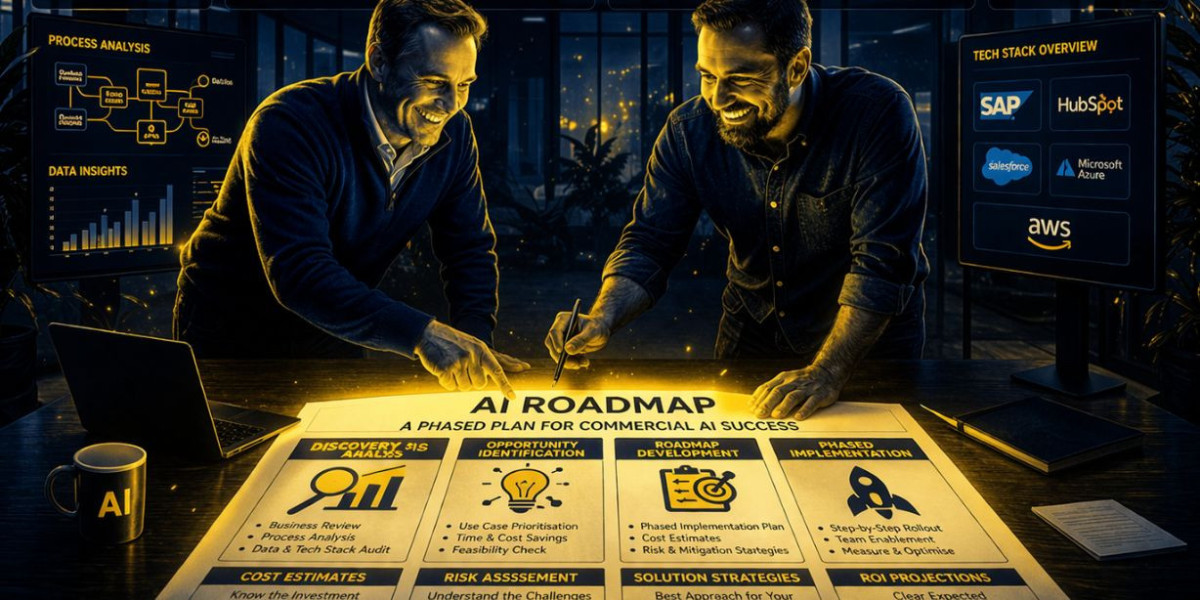

Artificial intelligence (AI) is transforming industries by improving efficiency, automating tasks, and enabling smarter decision-making. As AI continues to evolve, professionals and students alike are seeking structured ways to develop the skills needed to thrive in this exciting field. An Artificial Intelligence Roadmap provides a clear learning path, helping individuals progress from foundational concepts to advanced AI applications.
Whether you're a beginner or an experienced professional looking to expand your expertise, following a well-planned roadmap can make your AI learning journey more organized and effective.
Start with the Fundamentals
The first step in any Artificial Intelligence Roadmap is understanding the basic concepts of AI. Learn what artificial intelligence is, how it differs from machine learning and deep learning, and where it is applied in everyday life. Building a strong foundation also includes understanding algorithms, data, and how AI systems make decisions.
At this stage, it is helpful to develop basic programming knowledge, especially in Python, which is widely used for AI development due to its simplicity and extensive libraries.
Learn Mathematics and Statistics
Mathematics is the backbone of artificial intelligence. A solid understanding of linear algebra, probability, statistics, and calculus helps explain how AI models process data and make predictions.
While you do not need to become a mathematician, learning these core concepts will make it easier to understand machine learning algorithms and improve your problem-solving abilities.
Master Machine Learning
Machine learning is one of the most important stages in an Artificial Intelligence Roadmap. It enables computers to learn from data without being explicitly programmed for every task.
Focus on understanding supervised learning, unsupervised learning, and reinforcement learning. Learn how to train models, evaluate their performance, and improve their accuracy using real-world datasets.
Practical experience is essential. Work on small projects such as spam detection, recommendation systems, or customer behavior prediction to strengthen your skills.
Explore Deep Learning
Once you have mastered machine learning, move on to deep learning. This area of AI uses neural networks to solve complex problems such as image recognition, speech processing, and natural language understanding.
Learn about frameworks like TensorFlow and PyTorch, which simplify the process of building and training deep learning models. Hands-on projects help reinforce theoretical knowledge and prepare you for more advanced AI applications.
Build Real-World Projects
No Artificial Intelligence Roadmap is complete without practical experience. Creating AI projects allows you to apply your knowledge while building a portfolio that demonstrates your skills to potential employers.
Consider developing applications such as:
- AI-powered chatbots
- Image classification systems
- Sentiment analysis tools
- Predictive analytics models
- Voice recognition applications
These projects showcase your abilities and provide valuable problem-solving experience.
Stay Updated with Emerging Trends
Artificial intelligence is constantly evolving, making continuous learning essential. Keep up with developments in generative AI, natural language processing, computer vision, robotics, and AI ethics.
Reading research articles, following industry experts, attending webinars, and participating in AI communities can help you stay informed about the latest innovations and best practices.
Conclusion
An Artificial Intelligence Roadmap serves as a structured guide for anyone interested in building a successful career in AI. By learning the fundamentals, strengthening mathematical knowledge, mastering machine learning and deep learning, and gaining practical experience through real-world projects, you can develop the skills needed to succeed in this rapidly growing field.
As artificial intelligence continues to reshape industries worldwide, following a clear roadmap helps you stay focused, build confidence, and prepare for exciting career opportunities. With dedication, continuous learning, and hands-on practice, you can become a valuable contributor to the future of AI and innovation.